Nº 082 of 520
iOS app switcher stack
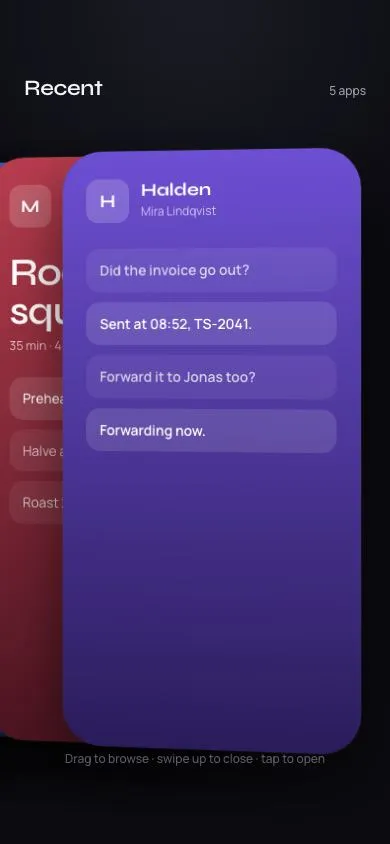
Five app cards fanned in a perspective stack: drag to browse, swipe up to fling one away and reflow, tap to expand it to full screen in 420ms.
Preview
Use it
Free to use · credit appreciated1 Once, in your project
npx skills add SusanAcharya/Design-Lounge 2 Then ask
Using the Design Lounge skill, build "iOS app switcher stack" (piece ios-app-switcher-stack) in my stack. Match its brief; restyle it onto my product's theme.
No skill? Paste the brief instead. It carries the numbers, tokens and behaviour.
<!-- Design Lounge Nº 082 · "iOS app switcher stack" · designlounge.vercel.app -->

# iOS app switcher stack

> **Build brief for a coding agent.** Rebuild this piece in the reader's stack. If they haven't said which stack, ask once, then default to semantic HTML + CSS + a little vanilla JS. Match the numbers below; don't "improve" them.

## What it is

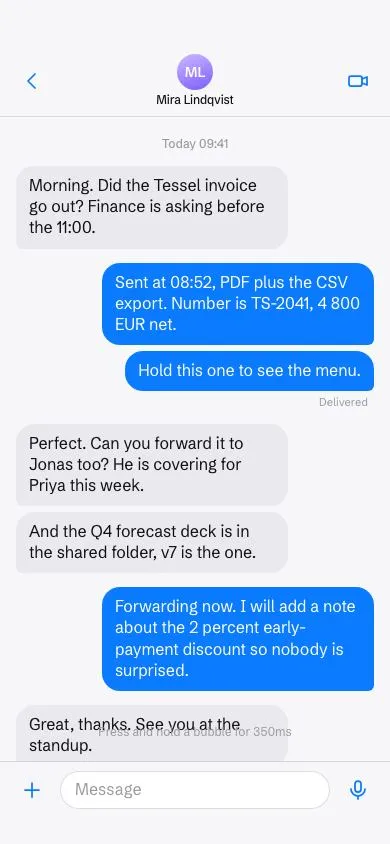
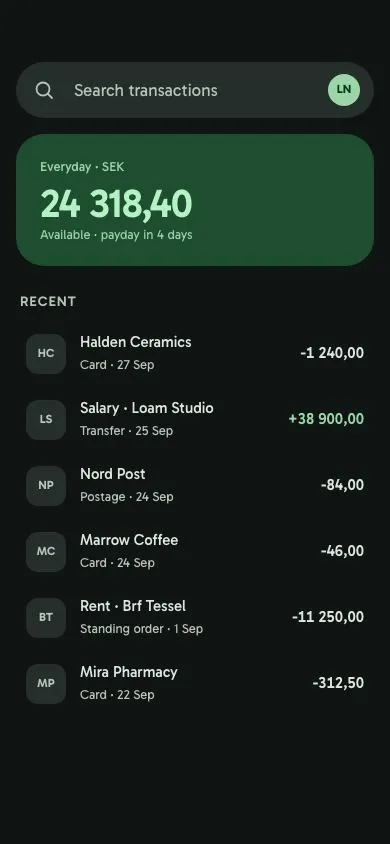
An iOS-style app switcher on a near-black background. Five 300×600 app cards (Fjord Bank, Nord Post, Orbital, Marrow, Halden — all fictional, each a flat two-tone gradient with real-looking screen content) are laid out as a horizontal fan: each card sits 80px to the right of the previous one, rotated −7° around Y inside a 1400px perspective, so the front card is fully visible and the older ones peek out on the left. Dragging horizontally scrolls the fan; dragging a card upward and releasing past 120px (or faster than 0.6px/ms) flings it off the top and the remaining cards reflow; tapping a card expands it to the full 390×844 frame in 420ms with the radius collapsing from 40px to 0. The detail worth copying is the single-transform layout: every card's position is three custom properties (`--x`, `--y`, `--s`) written by one `layout()` function, so drag, fling, reflow and expand all use the same CSS transition.

## Reference behaviour

1. Initial state: heading "Recent" (Syne 22/600) top-left at y = 76px with "5 apps" at the right; the fan is scrolled to its end so the newest card (Halden, purple) sits at x = 60px and the four older cards peek 80px each to its left; a caption "Drag to browse · swipe up to close · tap to open" sits at 64px from the bottom.
2. Pointer down on a card captures the pointer. After 6px of movement the gesture axis is locked to whichever of |dx|, |dy| is larger; the card gets `.drag`, which disables its transition so it tracks the finger 1:1.
3. Horizontal drag: `scroll = startScroll − dx`, clamped to `[0, (n−1) × 80]`. All cards recompute `--x = 60 + i × 80 − scroll` and move together (no transition while dragging).
4. Vertical drag: only the touched card moves; `--y = min(0, dy)` (cannot be dragged down).
5. Release after a vertical drag with `dy < −120px` or velocity `< −0.6px/ms`: the card gets `.gone` — it flies to `translateY(−900px)`, scales to .9 and fades to 0 over 320ms — and is removed from the list. The remaining cards reflow to their new `--x` over 380ms with `cubic-bezier(.2,.7,.2,1)`. The "N apps" counter updates.
6. Release after any drag that does not meet the fling threshold: the card springs back to `--y: 0` and the fan settles over 380ms.
7. Release with no movement (a tap): the card gets `.full` — `left/top` go to 0, `width/height` to 390×844, `border-radius` 40 → 0, transform to identity (no rotateY, scale 1) — all over 420ms with `cubic-bezier(.32,.72,0,1)`. The app content padding-top grows 28 → 70px on the same clock so the app title clears the status bar. Heading and caption fade out over 160ms. After the expansion, a footer line "Tap anywhere to return to the switcher" fades in.
8. Tapping the expanded card (any tap that arrives more than 400ms after opening) removes `.full`; the card shrinks back into its fan slot over 420ms; heading and caption return.
9. Keyboard: cards are `tabindex="0"`. Enter/Space toggles expand/collapse; Delete or Backspace flings the focused card; ArrowLeft/ArrowRight move focus and scroll that card to x = 60px; Escape collapses.
10. When every card has been flung: a centred "No recent apps" message with a 44px pill "Replay" button fades in over 240ms. Replay restores all five cards, scrolled to the end again.

## Structure

```
390 × 844
┌──────────────────────────────────────────┐
│ (54px status bar drawn by the Lounge)    │
│ Recent                          5 apps   │  y 76, Syne 22/600 · Manrope 12/500
│                                          │
│ ┃┃┃┃┌────────────────────────────┐       │  card top 150, 300 × 600, r 40
│ ┃┃┃┃│ [H] Halden                 │       │  older cards peek 80px each at
│ ┃┃┃┃│     Mira Lindqvist         │       │  x = −260, −180, −100, −20; front at 60
│ ┃┃┃┃│ ┌────────────────────────┐ │       │
│ ┃┃┃┃│ │ Did the invoice go out?│ │       │  rows: 14px chat lines, r 14
│ ┃┃┃┃│ └────────────────────────┘ │       │
│ ┃┃┃┃│ ┌────────────────────────┐ │       │
│ ┃┃┃┃│ │ Sent at 08:52, TS-2041.│ │       │
│ ┃┃┃┃│ └────────────────────────┘ │       │

… 181 more lines. Copy or download for the full brief. Loading the source…Brief
221 linesBuild brief for a coding agent. Rebuild this piece in the reader’s stack. If they haven’t said which stack, ask once, then default to semantic HTML + CSS + a little vanilla JS. Match the numbers below; don’t “improve” them.
What it is
An iOS-style app switcher on a near-black background. Five 300×600 app cards (Fjord Bank, Nord Post, Orbital, Marrow, Halden — all fictional, each a flat two-tone gradient with real-looking screen content) are laid out as a horizontal fan: each card sits 80px to the right of the previous one, rotated −7° around Y inside a 1400px perspective, so the front card is fully visible and the older ones peek out on the left. Dragging horizontally scrolls the fan; dragging a card upward and releasing past 120px (or faster than 0.6px/ms) flings it off the top and the remaining cards reflow; tapping a card expands it to the full 390×844 frame in 420ms with the radius collapsing from 40px to 0. The detail worth copying is the single-transform layout: every card’s position is three custom properties (--x, --y, --s) written by one layout() function, so drag, fling, reflow and expand all use the same CSS transition.
Reference behaviour
- Initial state: heading “Recent” (Syne 22/600) top-left at y = 76px with “5 apps” at the right; the fan is scrolled to its end so the newest card (Halden, purple) sits at x = 60px and the four older cards peek 80px each to its left; a caption “Drag to browse · swipe up to close · tap to open” sits at 64px from the bottom.
- Pointer down on a card captures the pointer. After 6px of movement the gesture axis is locked to whichever of |dx|, |dy| is larger; the card gets
.drag, which disables its transition so it tracks the finger 1:1. - Horizontal drag:
scroll = startScroll − dx, clamped to[0, (n−1) × 80]. All cards recompute--x = 60 + i × 80 − scrolland move together (no transition while dragging). - Vertical drag: only the touched card moves;
--y = min(0, dy)(cannot be dragged down). - Release after a vertical drag with
dy < −120pxor velocity< −0.6px/ms: the card gets.gone— it flies totranslateY(−900px), scales to .9 and fades to 0 over 320ms — and is removed from the list. The remaining cards reflow to their new--xover 380ms withcubic-bezier(.2,.7,.2,1). The “N apps” counter updates. - Release after any drag that does not meet the fling threshold: the card springs back to
--y: 0and the fan settles over 380ms. - Release with no movement (a tap): the card gets
.full—left/topgo to 0,width/heightto 390×844,border-radius40 → 0, transform to identity (no rotateY, scale 1) — all over 420ms withcubic-bezier(.32,.72,0,1). The app content padding-top grows 28 → 70px on the same clock so the app title clears the status bar. Heading and caption fade out over 160ms. After the expansion, a footer line “Tap anywhere to return to the switcher” fades in. - Tapping the expanded card (any tap that arrives more than 400ms after opening) removes
.full; the card shrinks back into its fan slot over 420ms; heading and caption return. - Keyboard: cards are
tabindex="0". Enter/Space toggles expand/collapse; Delete or Backspace flings the focused card; ArrowLeft/ArrowRight move focus and scroll that card to x = 60px; Escape collapses. - When every card has been flung: a centred “No recent apps” message with a 44px pill “Replay” button fades in over 240ms. Replay restores all five cards, scrolled to the end again.
Structure
390 × 844
┌──────────────────────────────────────────┐
│ (54px status bar drawn by the Lounge)    │
│ Recent                          5 apps   │  y 76, Syne 22/600 · Manrope 12/500
│                                          │
│ ┃┃┃┃┌────────────────────────────┐       │  card top 150, 300 × 600, r 40
│ ┃┃┃┃│ [H] Halden                 │       │  older cards peek 80px each at
│ ┃┃┃┃│     Mira Lindqvist         │       │  x = −260, −180, −100, −20; front at 60
│ ┃┃┃┃│ ┌────────────────────────┐ │       │
│ ┃┃┃┃│ │ Did the invoice go out?│ │       │  rows: 14px chat lines, r 14
│ ┃┃┃┃│ └────────────────────────┘ │       │
│ ┃┃┃┃│ ┌────────────────────────┐ │       │
│ ┃┃┃┃│ │ Sent at 08:52, TS-2041.│ │       │
│ ┃┃┃┃│ └────────────────────────┘ │       │
│ ┃┃┃┃│ ...                        │       │
│ ┃┃┃┃└────────────────────────────┘       │  card bottom 750
│                                          │
│ Drag to browse · swipe up to close · tap │  caption, bottom 64
└──────────────────────────────────────────┘
   perspective 1400px, origin 50% 40%; every card rotateY(−7deg)
<div class="top">— absolute,top: 54px; padding: 22px 24px 0;<h1>+<span id="count">.<div class="stage" role="list">— absolute inset 0,perspective: 1400px; perspective-origin: 50% 40%.<article class="card" role="listitem" tabindex="0" aria-label="<app>">× 5, each with inline--c1/--c2(top and bottom of its gradient)..app— flex column,padding: 28px 24px 24px, gradient--c1 → --c2..id— 44px rounded icon (initial letter, Syne 18/700) + app name (Syne 18/700) + 12px subtitle.- Optional
.big(Syne 40/600 figure) +.sub(13px), optional.bars(7 bars, 80px tall sparkline),.rows(14px pills,rgba(255,255,255,.12);.ghostrows at.07).
.done— absolute bottom caption inside the card, visible only in.full.
<p class="foot">— absolute,bottom: 64px, centred, 12px/500 tertiary ink.<div class="empty">— absolute inset 0 grid, hidden until the list is empty; contains<p>and<button id="replay">.
Tokens
:root {
  /* colour — near-black stage, cool neutrals, five app pairs (top / bottom of gradient) */
  --bg: #0b0b10;            /* stage base; radial highlight #1b1b26 at top */
  --bg-2: #17171f;
  --ink: #f4f3f7;           /* heading, empty-state text, replay button fill */
  --ink-2: #a09fae;         /* counter, empty-state secondary */
  --ink-3: #5d5c6b;         /* caption */
  --line: rgba(255,255,255,.08);
  --a1: #1f6f5a; --a1-2: #0f3b30;   /* Fjord Bank, green */
  --a2: #e0632a; --a2-2: #6d2a10;   /* Nord Post, orange */
  --a3: #2b62d9; --a3-2: #0e2354;   /* Orbital, blue */
  --a4: #b83c4e; --a4-2: #4b1420;   /* Marrow, red */
  --a5: #6c4fd3; --a5-2: #2a1c5a;   /* Halden, violet */

  /* type */
  --font: "Manrope", system-ui, sans-serif;
  --display: "Syne", system-ui, sans-serif;

  /* layout */
  --card-w: 300px;
  --card-h: 600px;
  --card-top: 150px;
  --card-x0: 60px;          /* x of the card scrolled into front position */
  --step: 80px;             /* horizontal gap between stacked cards */
  --r-card: 40px;

  /* elevation */
  --shadow-card: 0 24px 60px rgba(0,0,0,.55), 0 0 0 1px rgba(255,255,255,.06);

  /* motion */
  --t-reflow: 380ms;
  --t-fling: 320ms;
  --t-expand: 420ms;
  --t-micro: 160ms;
  --ease: cubic-bezier(.2, .7, .2, 1);
  --sheet: cubic-bezier(.32, .72, 0, 1);
  --expo: cubic-bezier(.16, 1, .3, 1);
}
Typography
| Role | Family | Size | Weight | Line-height | Tracking | Case |
|---|---|---|---|---|---|---|
| Switcher heading | Syne | 22px | 600 | 1.1 | −0.02em | sentence |
| App name | Syne | 18px | 700 | 1.1 | −0.01em | sentence |
| App icon letter | Syne | 18px | 700 | 1 | 0 | UPPER |
| Big figure | Syne | 40px | 600 | 1 | −0.03em | numerals |
| Empty-state title | Syne | 20px | 600 | 1.2 | 0 | sentence |
| App subtitle | Manrope | 12px | 400 | 1.3 | 0 | sentence |
| Figure caption | Manrope | 13px | 400 | 1.4 | 0 | sentence |
| Row text | Manrope | 14px | 500 | 1.3 | 0 | sentence |
| Row value | Manrope | 14px | 600 | 1.3 | 0 | numerals |
| Counter / caption | Manrope | 12px | 500 | 1.3 | 0 | sentence |
| Replay button | Manrope | 14px | 600 | 1 | 0 | sentence |
Motion
| Element | Trigger | Property | From → To | Duration | Easing | Notes |
|---|---|---|---|---|---|---|
.card | horizontal drag | --x (transform) | tracks finger 1:1 | 0 | none | .drag sets transition: none |
.card | vertical drag | --y (transform) | min(0, dy) | 0 | none | only the touched card |
.card | release, no fling | transform | dragged → resting slot | 380ms | --ease | |
.card.gone | fling | transform, opacity | y 0 → −900px, s → .9, 1 → 0 | 320ms | --ease | pointer-events: none, aria-hidden |
| siblings | fling | --x (transform) | old slot → new slot | 380ms | --ease | reflow starts in the same frame as the fling |
.card.full | tap | width, height, top, left, radius, transform | 300×600 @ (x,150), r40, rotateY −7° → 390×844 @ (0,0), r0, identity | 420ms | --sheet | z-index 20 |
.full .app | tap | padding-top | 28px → 70px | 420ms | --sheet | same clock |
.done | expansion | opacity | 0 → 1 | 160ms | --ease | delay 420ms |
.top, .foot | expansion / empty | opacity | 1 → 0 | 160ms | --ease | .dim class |
.empty | last card flung | opacity | 0 → 1 | 240ms | --ease | |
| depth scale | any reflow | --s (transform) | 1 − depth × 0.02 (front 1, back .92) | 380ms | --ease | depth = distance from the front card |
Reduced motion: all transition durations and delays become 1ms and the rotateY(−7deg) is dropped (cards stack flat). Drags still track the finger because dragging has no transition to begin with.
States
- Resting card:
translate3d(--x, 0, 0) rotateY(−7deg) scale(--s),--shadow-card,cursor: grab, z-index = index + 1 so newer cards overlap older ones. - Dragging:
.drag— transition off,cursor: grabbing. - Flung:
.gone— off-screen, transparent,aria-hidden="true",tabindex="-1", no pointer events; kept in the DOM for Replay. - Expanded:
.full— fills the frame,aria-expanded="true",cursor: default,.donecaption visible. - Focus-visible (card): 3px white outline, −3px offset (inside the radius so it is not clipped).
- Focus-visible (Replay): 2px
--inkoutline, 3px offset. - Empty:
.empty.on— heading and caption dimmed, message and Replay button shown.
Accessibility
- The stage is
role="list"; each card isrole="listitem"witharia-labelset to the app name andtabindex="0". Expanded state is exposed witharia-expanded. - Keyboard: Tab through cards in DOM order (oldest first). Enter / Space toggle expand. Delete / Backspace fling the focused card and move focus to the new front card (or to Replay when none remain). ArrowLeft / ArrowRight move focus between neighbours and scroll that card into the front slot. Escape collapses an expanded card.
- Pointer capture (
setPointerCapture) keeps a drag alive when the finger leaves the card’s box. touch-action: noneon<body>so the browser never claims a vertical swipe as a scroll; there is nothing else to scroll on this screen.- Contrast:
--inkon--bg18:1;--ink-28.7:1; the 12px caption in--ink-3is decorative (3.1:1) and duplicated by the keyboard affordances above. White text on every gradient bottom colour is ≥ 8:1; on the top colours (--a2orange 3.6:1,--a3blue 5.3:1) only 18px bold and 40px text is placed, which meets AA large-text. - Hit targets: cards are 300×600; Replay is 44px tall.
Responsive rules
- 390 × 844 (reference): as specified.
- 360 wide: keep the 300px card and 80px step; set
--card-x0: 45pxso the front card keeps a 15px right gutter. - Heights below 780: reduce
--card-hto 70% of the viewport height and--card-topto54px + 96px; the expand target is always the full viewport, so readinnerWidth/innerHeightinstead of the 390/844 literals. - ≥ 600 wide (tablet):
--card-w: 340px,--step: 120px,--card-x0: calc(50% − 170px); perspective-origin stays at 50% 40%. - Pointer devices: horizontal wheel/trackpad scrolling should also drive
scroll; hover raises the front card’s shadow by 8px (optional).
Acceptance checklist
- Five 300×600 cards with 40px radius, stacked 80px apart, rotated
rotateY(−7deg)insideperspective: 1400px. - On load the fan is scrolled to its end: the newest card is at x = 60px and the oldest four peek 80px each to the left.
- Horizontal drag moves all cards 1:1 with the pointer and clamps at both ends (no rubber-banding required).
- Vertical drag moves only the touched card and never below its resting y.
- Releasing at
dy < −120pxorvelocity < −0.6px/msflings the card (−900px, opacity 0, 320ms); otherwise it snaps back over 380ms. - Remaining cards reflow over 380ms with
cubic-bezier(.2,.7,.2,1)and the counter decrements. - A tap (no movement beyond 6px) expands the card to 390×844 in 420ms with
cubic-bezier(.32,.72,0,1); radius animates 40 → 0 and the rotation returns to 0. - The card’s own click does not immediately collapse it (ignore clicks within 400ms of opening).
- Tapping the expanded card returns it to its slot in 420ms; heading and caption fade back in.
- Enter/Space, Delete/Backspace, ArrowLeft/ArrowRight and Escape behave as specified with visible focus rings.
- When all cards are flung, “No recent apps” and a 44px Replay button appear; Replay restores all five.
- Under
prefers-reduced-motion: reduce, cards are flat (no rotateY) and every transition is 1ms. - No console errors when flinging during a reflow or tapping during an expansion.
Implementation notes
One layout function, three custom properties. Never write transform per card by hand; compute the slot and let the base rule compose it:
function layout() {
  const n = cards.length, max = Math.max(0, (n - 1) * STEP);
  scroll = Math.min(max, Math.max(0, scroll));
  cards.forEach((c, i) => {
    const depth = n - 1 - i;
    c.style.setProperty('--x', X0 + i * STEP - scroll + 'px');
    c.style.setProperty('--s', (1 - depth * 0.02).toFixed(3));
    c.style.zIndex = i + 1;
  });
}
.card { transform: translate3d(var(--x), var(--y), 0) rotateY(-7deg) scale(var(--s));
transition: transform var(--t-reflow) var(--ease), opacity var(--t-fling) var(--ease),
width var(--t-expand) var(--sheet), height var(--t-expand) var(--sheet),
top var(--t-expand) var(--sheet), border-radius var(--t-expand) var(--sheet); }
.card.drag { transition: none; }Lock the gesture axis once. Decide after 6px and never re-decide, otherwise a diagonal swipe both scrolls and lifts:
if (!d.axis && Math.abs(dx) + Math.abs(dy) > 6) {
  d.axis = Math.abs(dx) > Math.abs(dy) ? 'x' : 'y'; d.moved = true; d.c.classList.add('drag');
}
if (d.axis === 'x') { scroll = d.s - dx; layout(); }
else if (d.axis === 'y') d.c.style.setProperty('--y', Math.min(0, dy) + 'px');
Expand by overriding the slot, not by cloning. .full sets --x: 0; --y: 0; --s: 1, left/top: 0, width/height to the frame and transform: translate3d(0,0,0) rotateY(0) scale(1); because the base rule already transitions width, height, top and border-radius, the expansion needs no JS measurement. Give .full z-index: 20 !important since layout() writes inline z-indexes.
Common mistakes: forgetting setPointerCapture, so a fast upward fling loses the pointer at the card edge; using left for the horizontal scroll (layout thrash on every move); attaching the collapse to click without the 400ms guard, which makes the same tap that opened the card close it; hiding flung cards with display: none, which removes them from the Replay path and breaks the 320ms exit.
Details
- Palette
- Type
- Syne · Manrope
- Motion
- Rich motion
- Build
- Multi-step
- Tags
On the shelves